How much does a Shopify store cost in 2026?
The plan price is only one part of the bill. Here is everything a Shopify store really costs, from the monthly plan to payment fees, themes, apps and design, with realistic first-year budgets for three kinds of store.
 By Asim Baloch, Founder of Tangle Logics
Updated · 5 min read

The short answer
For most small businesses, a Shopify store costs:
- $500 to $1,500 in the first year if you set it up yourself on a free theme
- $2,500 to $6,000 in the first year if a professional sets it up on a premium theme
- $5,000 to $12,000 or more in the first year for a custom-designed store with custom features
After the first year, most of the build cost disappears and you pay mainly for the plan, apps and payment fees. The rest of this guide explains where each number comes from, so you can work out your own.
Shopify plan prices
Shopify charges a monthly subscription. In the United States, the list prices when paid monthly are:
- Basic: $39 a month. Everything a new store needs to sell online, for one owner.
- Grow: $105 a month. Adds staff accounts and lower card fees, for small teams.
- Advanced: $399 a month. More staff accounts, advanced reports and lower card fees again, for growing brands.
- Plus: from about $2,300 a month. For high-volume and complex businesses, with a fully customisable checkout and more.
Paying for a year up front lowers the monthly price, and Shopify regularly runs free trials and low-cost first months. Shopify also changes and tests its prices and they differ by country, so always check the current figures on Shopify's own pricing page before you budget.
Payment processing fees
Every card payment carries a fee. With Shopify Payments, the online rate falls as you move up the plans: around 2.9% plus 30 cents per sale on Basic in the United States, lower on Grow and Advanced, and negotiable on Plus. If you use a different payment provider instead of Shopify Payments, Shopify adds its own extra transaction fee on top of that provider's charges.
On $10,000 of monthly sales, payment fees alone can come to roughly $300 a month, so for many stores they cost more than the plan itself. This is the number most budgets forget.
Your domain name
A domain such as yourbrand.com costs around $15 to $25 a year. You can buy it through Shopify or any domain registrar and connect it to your store.
Themes
A theme controls how your store looks. You have three options:
- A free theme. Shopify's free themes are clean and fast, and a good starting point if your budget is tight.
- A premium theme. Paid themes from the Shopify Theme Store usually cost a few hundred dollars, once, and offer more layouts and features.
- A custom theme. Designed and built for your brand, so your store does not look like thousands of others. This is part of the design and development cost below.

Apps
Apps add features Shopify does not include out of the box: product reviews, subscriptions, upsells, bundles, loyalty programmes, advanced search, email marketing and more. Many have free plans; paid apps typically cost $5 to $50 a month each.
A typical small store ends up with five to ten apps and spends around $50 to $200 a month on them. Apps are also where costs creep up over time, so review them every few months and remove any you no longer use.
Design and development
This is the biggest variable, and it depends on how much is custom:
- Set-up on a premium theme: around $1,500 to $3,000. Configuring the theme, your brand colours and fonts, collections, product pages, navigation, payments, shipping, taxes and the essential apps.
- Custom design and development: around $3,000 to $7,500. A store designed around your brand and products, with custom sections, product page layouts and features such as bundles, gift sets or a cart drawer.
- Complex or high-volume stores: $7,500 and up. Custom functionality, integrations with your inventory or accounting systems, migrations from another platform with SEO redirects, or Shopify Plus builds.
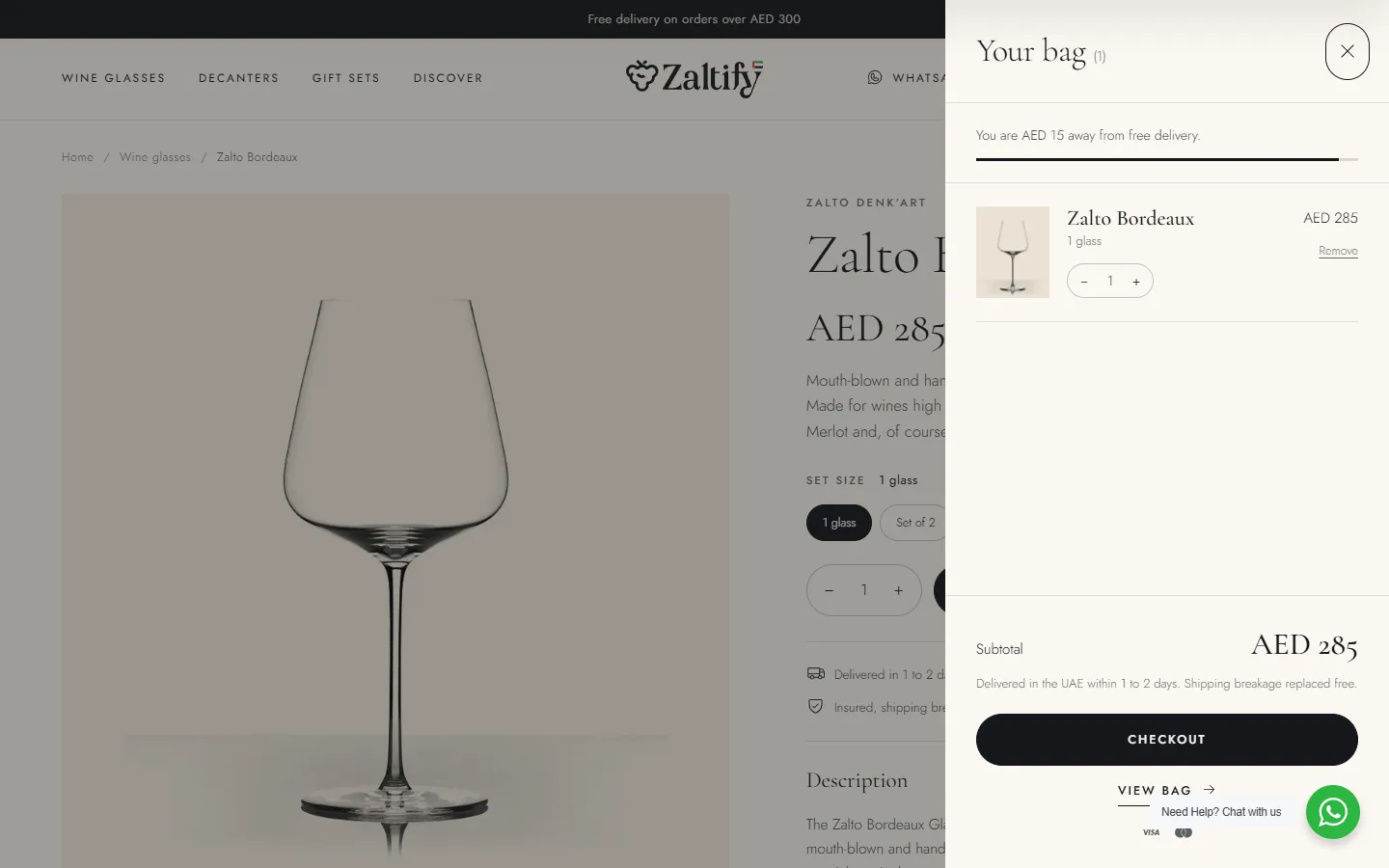
For example, our custom Shopify 2.0 store for Zaltify, with a video homepage, custom collection and product layouts, gift sets, an AJAX cart drawer, reviews, WhatsApp and fixed ad tracking, sat in the $1,000 to $2,500 range and took under a month.
Photography, content and marketing
Good product photos and clear product descriptions sell more than almost any feature. Budget for product photography if you cannot shoot your own, and for writing or editing product copy. Most stores also need some launch marketing, whether paid ads, email or social media, which is separate from the cost of the store itself.
Three realistic first-year budgets
1. A do-it-yourself starter store
- Basic plan, paid monthly: about $470 a year
- Free theme: $0
- A few apps: $0 to $50 a month
- Domain: about $20
- First year: roughly $500 to $1,500, plus payment fees on your sales
2. A professionally set-up store
- Basic or Grow plan: about $470 to $1,260 a year
- Premium theme: a few hundred dollars, once
- Set-up and design: $1,500 to $3,000
- Apps: $50 to $150 a month
- First year: roughly $2,500 to $6,000, plus payment fees
3. A custom-designed store
- Grow or Advanced plan: about $1,260 to $4,800 a year
- Custom design and development: $3,000 to $7,500 or more
- Apps and integrations: $100 to $300 a month
- First year: roughly $5,000 to $12,000 or more, plus payment fees
Planning a new website?
Send us your current site or your idea. We reply within 24 hours with the recommended approach, timeline and a fixed quote.
How to keep costs down
- Start on the Basic plan and upgrade only when the numbers justify it
- Pay yearly once you are sure the store is working
- Choose a theme that already has the features you need, instead of adding apps for them
- Audit your apps every few months and cancel the ones you do not use
- Ask your developer to build simple features into the theme rather than adding more paid apps
- Get the structure right at launch: collections, navigation and product pages are cheaper to plan than to rebuild
Is Shopify worth it?
For most product businesses, yes. Hosting, security, updates and a high-converting checkout are all included in the monthly price, so you are not paying a developer to maintain a server. If you need complete control over every feature, or you run content-heavy or service businesses alongside your shop, WooCommerce on WordPress can be the better fit. We build on both, and we will tell you honestly which one suits you on your discovery call.
Get a fixed quote for your store
Tell us about your products and what your store needs. We'll reply within 24 hours with a recommended approach, a timeline and a fixed quote, so you know the cost before you start.